
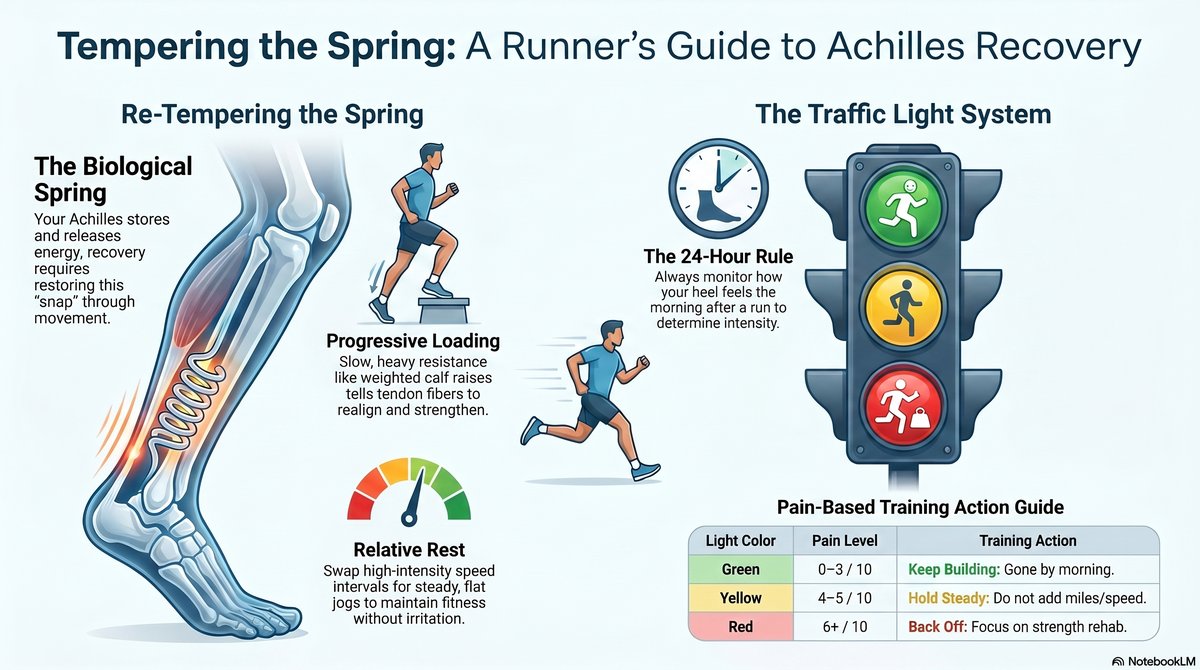
If you're a runner, your Achilles tendon is your superpower. It's not just a connector; it's a high-performance biological spring that stores and releases energy with every single stride. When that spring is working well, running feels light and efficient. But when it starts to ache, it feels like that spring has been replaced by a piece of rusty wire.
The biggest mistake we make when Achilles pain strikes is treating it like a "string" that's about to snap. We stop moving, we stretch it obsessively, and we wait for the pain to vanish. But tendons are unique. Unlike muscles that need rest to heal, tendons actually thrive on tension.
The Rebuild Phase
When your Achilles is sensitive, it's often because it has lost its ability to handle the "rebound" of running. The goal of your recovery isn't just to wait for the pain to go away — it's to restore the "snap" to that spring.
This is where progressive loading comes in. By doing slow, heavy resistance training — like weighted calf raises — you're essentially "re-tempering" the spring. You're telling those tendon fibers to realign and get back to work.
Keep Moving, Just Differently
You don't have to disappear from the running community while this happens. Recovery is about relative rest, not total rest. You might swap your speed intervals for a steady, flat jog, or use a "24-hour rule" to monitor how your heel feels the morning after a run.
To help you navigate your training, use this Traffic Light System. It's the simplest way to tell if you're building resilience or just building irritation.
- Green Light (Keep Building): Your pain is a whisper (0–3/10). It might be there, but it doesn't change your form and it's gone by tomorrow morning.
- Yellow Light (Hold Steady): You're hitting a 4 or 5 out of 10. You can finish the run, but you might feel extra stiff the next day. This is your "ceiling" — don't add more miles or speed until this run feels like a Green Light.
- Red Light (Back Off): If you're limping, hitting a 6+/10 pain, or still hurting 24 hours later, you've overloaded the spring. It's time to pivot to your strength rehab and dial back the running intensity.
Use the Traffic Light System consistently: Don't judge a single run in isolation — track patterns over a week. One yellow day surrounded by green days is fine. Repeated yellows or any reds mean the load needs to come down before you progress."The finish line isn't just 'pain-free.' It's building a tendon that is more resilient and more responsive than the one you started with."
You aren't just "fixing" an injury; you're upgrading your equipment.
If you want a structured plan to work through this process step by step, the Achilles rehab program walks you through every phase — from early loading to return to running. Or if you'd rather talk through your specific situation, book a session and we can build a plan together.
Free guide
Get the free Achilles Recovery Guide
12 pages covering loading progressions, pain monitoring, morning stiffness, and more.

Paul Cramer, RMT
Registered Massage Therapist with a clinical focus on tendon rehabilitation. Founder of PainFreeTendon — evidence-informed guidance for people with tendon pain.
Read more about Paul →