
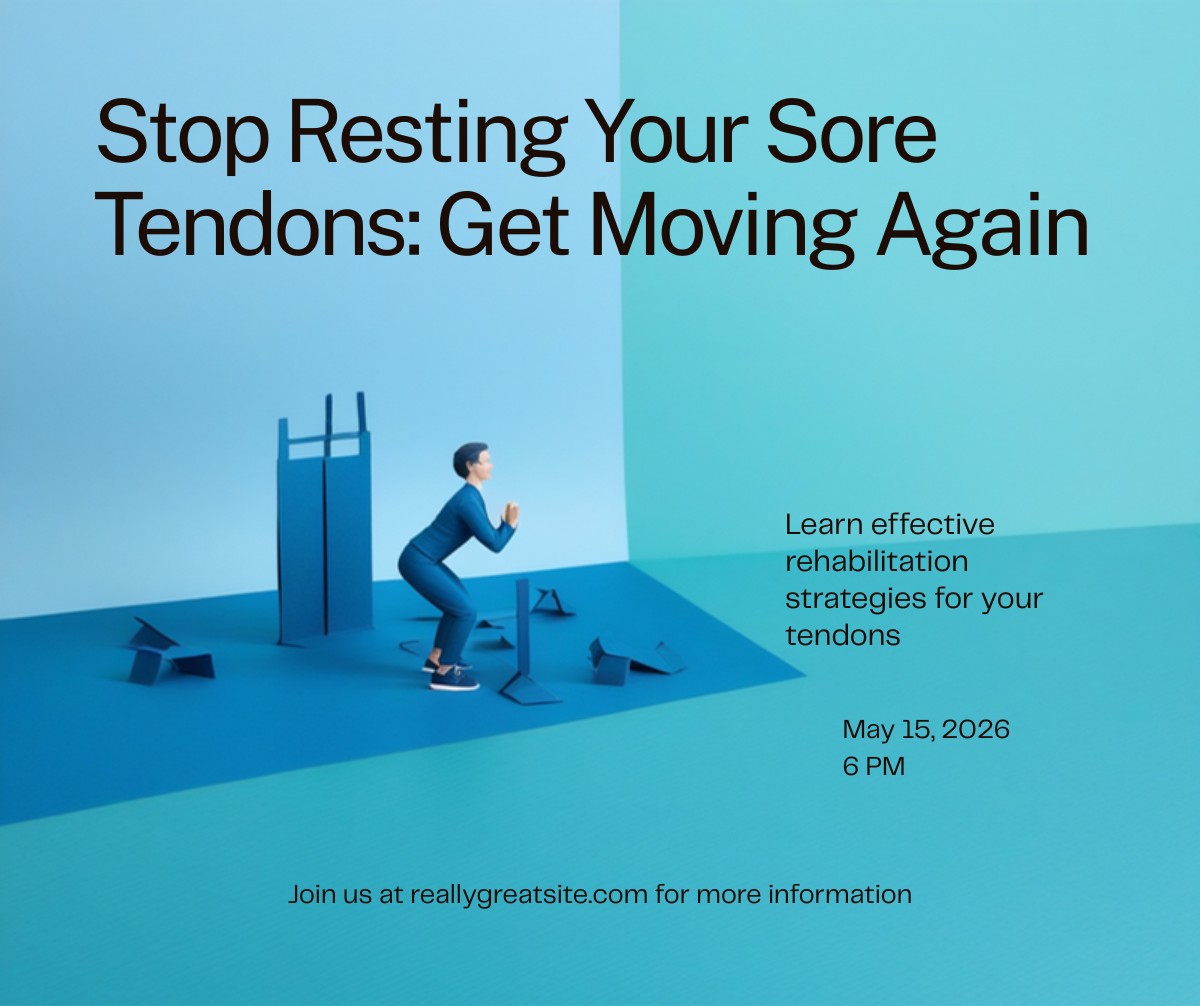
If you have been struggling with persistent tendon pain — whether it's your Achilles, your elbow, or your heel — you likely know the "rest trap" all too well. You feel a flare-up, you stop all activity, and the pain eventually settles. You feel optimistic and head back to the gym or out for a run, only for that familiar, sharp pain to return almost immediately.
I know how incredibly frustrating this cycle is. As a clinician, I see people stuck here every day. The reason you're stalled is likely because you're treating your tendon like it's "inflamed" and needs to be cooled off. In reality, modern research tells us that tendinopathy is not an inflammatory problem — it is a problem of load vs. capacity. Your tendon isn't "broken." It is simply underprepared for the demands of your life.
Why Complete Rest is Actually the Enemy
When a tendon hurts, our protective instinct is to leave it alone. But while absolute rest might settle your pain temporarily, it's the quickest way to weaken the tissue. Tendons are specialized structures that require load to stay healthy. When you stop moving entirely, your tendon's capacity to handle force drops.
This creates a self-sabotaging loop: too much rest makes the tendon even less prepared for activity, leading to a flare-up the second you return to your sport. The answer is what I call Relative Rest. This doesn't mean doing nothing — it means finding the threshold of tolerable load that keeps the tissue active without pushing it into a reactive state.
"Rest may settle pain for a short time, but it often does not improve the tendon's ability to cope with walking, running, jumping, gym training, or sport."
This is counter-intuitive because we've been conditioned to believe that pain always equals damage. With tendons, total unloading is actually a signal to the tissue to become weaker and less resilient.
The "Doughnut" Metaphor — Focus on the Healthy Tissue
If you've had an MRI or ultrasound, you might have seen scary words like "degenerative changes" or "disorganization." I want you to know right now: those images are not a life sentence. Research shows that pathology can exist on imaging without the tendon being the source of your symptoms.
Think of your tendon like a doughnut. The "hole" is the area of pathology — the part where the fibers are disorganized. This area is often mechanically silent, meaning it is unable to transmit or sense tensile load and cannot easily be reversed. However, the "doughnut" is the surrounding healthy, well-aligned fibrillar structure. Even a "damaged" tendon often has a large amount of healthy tissue that has already compensated by increasing in size.
Your Brain Has "Rewired" the Pain Response
Persistent tendon pain isn't just a hardware issue in your heel or elbow — it's also a software issue in your brain. Chronic pain changes your motor cortex, the part of the brain that controls your muscles, creating what researchers call a Tendon-Brain Connection.
In people with tendinopathy, the corticospinal tract begins to send conflicting signals. It's a bit like driving with one foot on the gas and one on the brake — simultaneous excitation and inhibition. This "braking" signal is a protective false alarm, but it prevents your muscles from firing efficiently.
This is why simple weight lifting isn't always enough. Tendon Neuroplastic Training uses externally paced cues — like a metronome — to help the brain override that internal braking signal, reorganizing the motor cortex and restoring proper control over the kinetic chain.
The Hidden Danger of Stretching
One of the most common mistakes people make is aggressive stretching. If you have Achilles pain, the location of your symptoms matters enormously. Mid-portion pain occurs 2–6 cm from the heel bone, while insertional pain sits less than 2 cm from the bone.
If your pain is insertional, stretching is often your worst enemy — because of compression. When you drop your heel off a step or run uphill, the tendon is compressed against the calcaneus (heel bone). This compression is a primary trigger for pain. For insertional presentations, the rule is to stay in a plantarflexion range: performing heel raises on flat ground builds strength without the irritating compressive force.
Loading is the "Missing Signal" for Healing
To truly recover, we need mechanotransduction — the process where physical load acts as a chemical signal to tendon cells, telling them to reorganize and rebuild. Tendons love load, but it must be heavy and it must be progressive.
A well-structured rehabilitation program moves through three stages:
- Isometrics: Holding a heavy load in a still position for 45 seconds. To achieve a meaningful analgesic (pain-relieving) effect, these must be held at approximately 80% of your Maximum Voluntary Contraction.
- Isotonics / Heavy Slow Resistance (HSR): Slow, controlled repetitions using heavy weights (greater than 75% of your 1-rep max). This addresses kinetic chain deficits and builds muscle-tendon bulk without the shock loading of fast movements.
- Energy Storage / Plyometrics: Retraining the tendon's spring-like function through faster movements like jumping or hopping — reserved for the later stages of rehab.
From Protection to Preparation
The path back requires a total shift in mindset. We have to stop protecting a damaged tissue and start preparing it for the demands of your sport. A tendon that is protected forever stays weak forever. A tendon that is prepared becomes resilient.
"Tendons don't just need protection. They need preparation."
My challenge to you today: what is one small, controlled way you can start loading your "doughnut" to prove to your brain that you are safe?
If you want to understand what progressive loading actually looks like in practice — specifically for the Achilles — my complete guide to heel raises walks through every stage of the process. And if you'd like help building a structured plan around your specific situation, you can book a 1-on-1 session with me directly.
Free guide
Get the free Achilles Recovery Guide
12 pages covering loading progressions, pain monitoring, morning stiffness, and more.

Paul Cramer, RMT
Registered Massage Therapist with a clinical focus on tendon rehabilitation. Founder of PainFreeTendon — evidence-informed guidance for people with tendon pain.
Read more about Paul →